In September, 2023 I visited the Belfast Book Fair, held this year in Methodist College (Methody) at Stranmillis. There was little in interest this year, by way of books, (mostly Irish history etc), but there were a couple of dealers selling antique postcards, and I spent quite a time trawling through them – with no intention of buying, of course, (some of these antique postcards can be rather expensive), despite the enthusiastic sales techniques of one of the vendors, who mistook my prolonged browsing for a potential sale. I was looking for photographic inspiration! Actually, I was sorry I hadn’t taken a notebook and pen!
But here’s a free shout out to Belfast Book Fair… http://belfastbookfair.com
The postcards were filed according to county, and within the counties, by town, and I found a small section of Randalstown postcards. Now Randalstown is of course quite a scenic area, a small conservation town, with old buildings, a former railway viaduct, a major river, a forest park, – what more could a 1940s’ photographer want form his postcard offering? But what caught my eye was a postcard with a photograph of a terrace of houses on the Portglenone Road, a terrace of houses that I pass by, either on foot or in the car, every day, and which I had never considered as a photographic subject before. (That’s the real value of old postcards IMO!) The road is in the townland of Feehogue, and is called Feehogue Crescent, and is a delightfully quaint row of old stone houses.
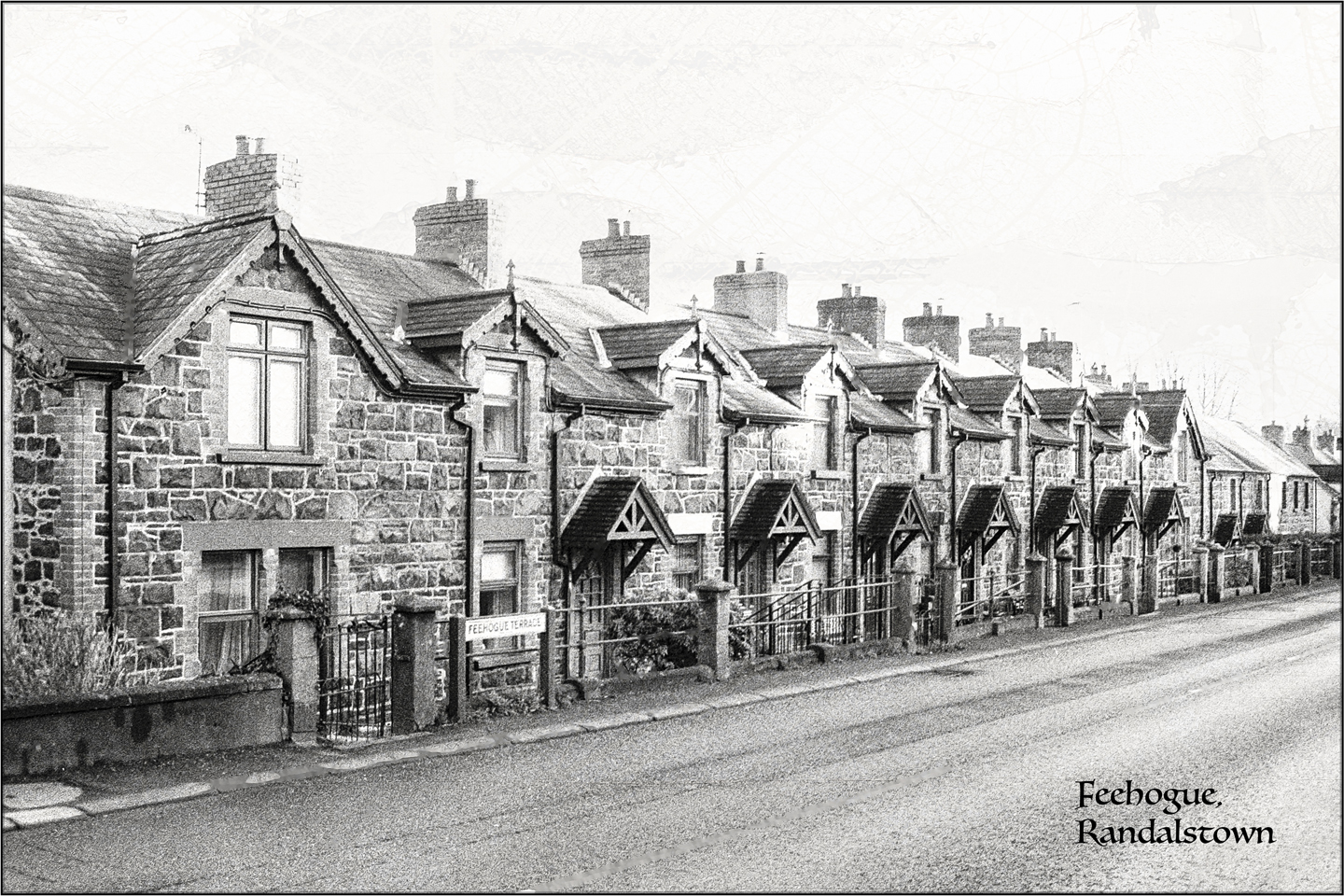
Because I’d no intention of buying a postcard, I decided to make a replica. On a late November day, I walked down to the vantage point where I assumed the original photograph had been made. . I took the Nikon FM3a camera, with a 50mm f/1.8 Nikon lens, – the camera loaded with Ilford HP5, a 400ISO, a 400ISO, reasonably grainy emulsion, which should be more or less like what the 1040’s photographer would have had in his camera. I made three exposures, bracketing at 2/3 stop. The developing was straightforward, 7 minutes in Fotospeed FD10 at 20 degrees C, two minutes stop in water, then 5 minutes fixer, 10 minutes wash. When the negatives were dried, they were scanned and imported to a computer. The negs were so good that little or no Photoshop adjustment or correction was needed.
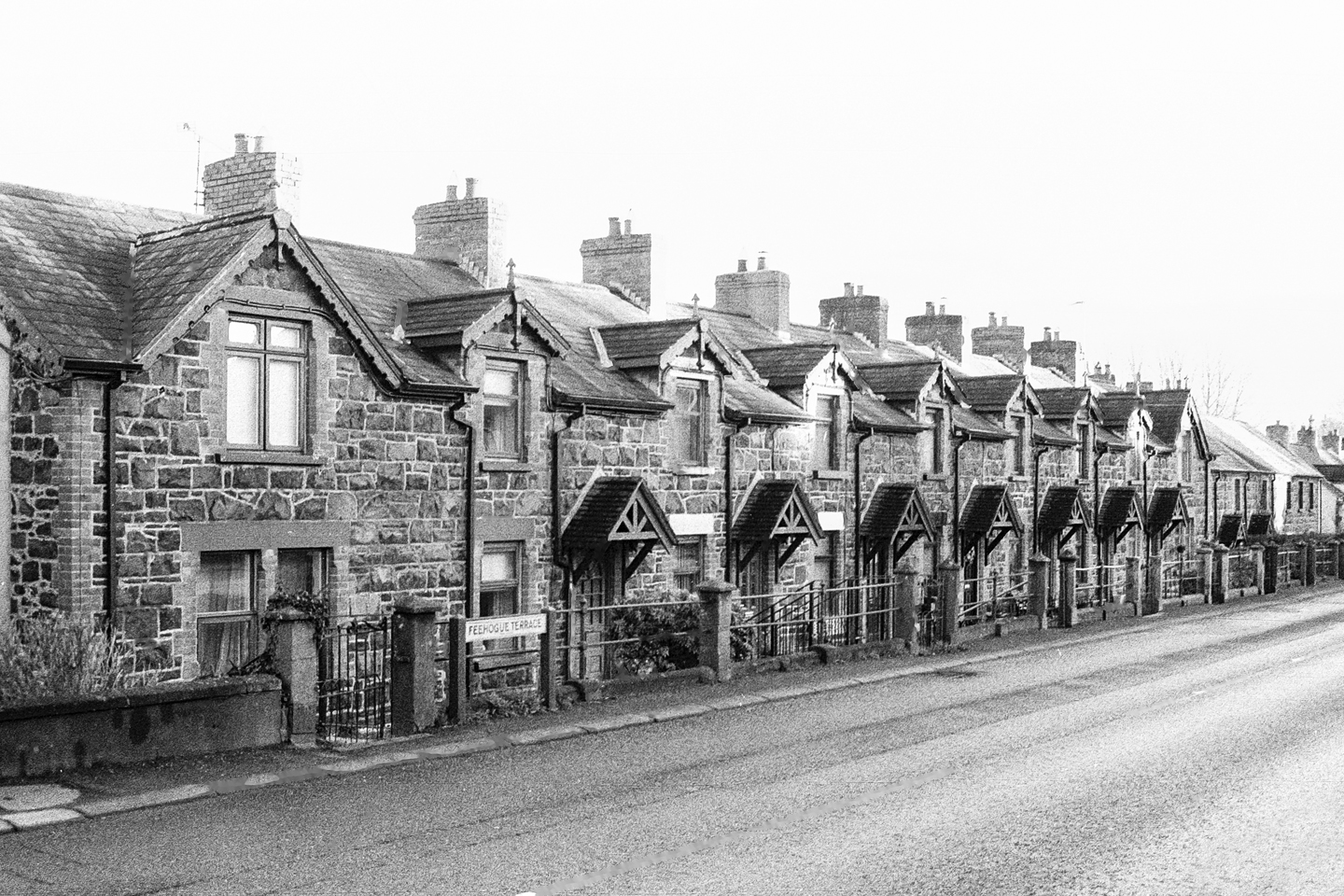
But that had made a lovely monochrome image of Feehogue, and I was trying to replicate a 1940’s postcard with 80 years of aging. The postcard had the name of the street printed on it, and I reproduced this using Luminari, the closest font to what I remembered on the original.
Then I aged it, overlaying a tiny amount of sepia, and some artificial deterioration on the sky.
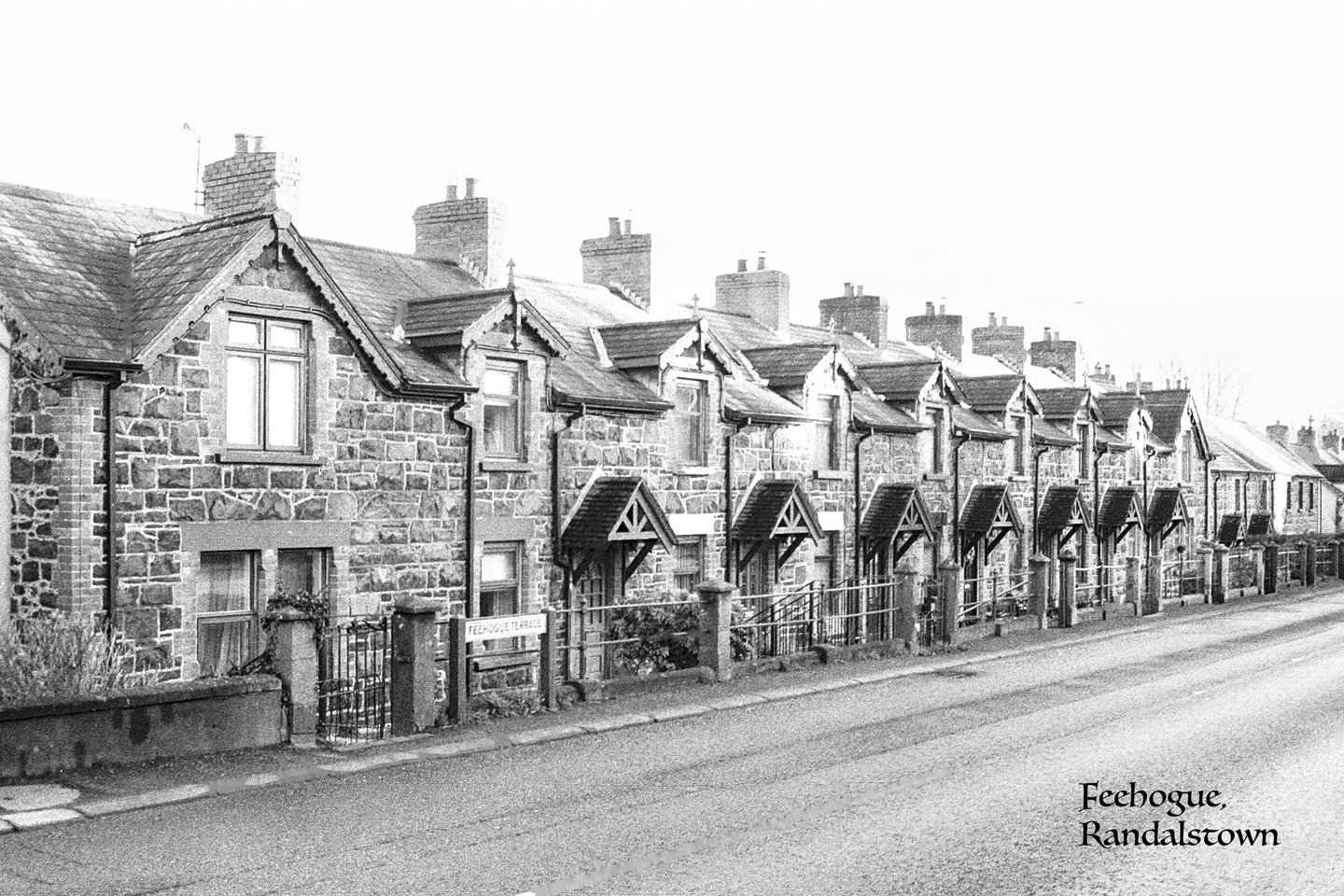
I had a postcard! And it didn’t cost me £25! Yes, I know. I’m a miserable sod, but this way was more fun!
 Portraits2Go.co.uk