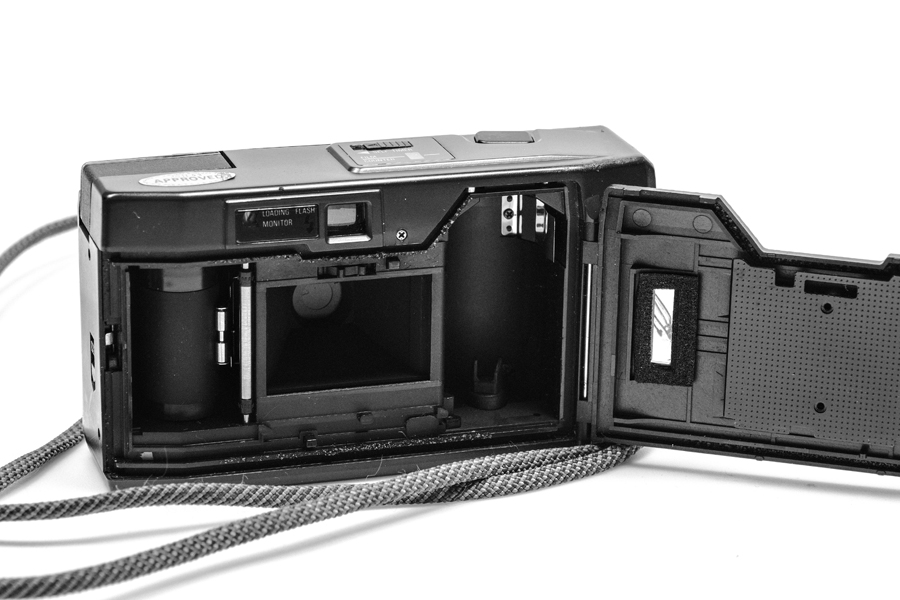
Another example from my weird collection of cameras and photographic bits and pieces gathered up from friends, relatives and charity shops. This little film compact camera is the Ricoh XF-30. Mine is black – but I’ve seen a few nice red examples on the second hand market.

The Ricoh X-F30 was manufactured in Japan between 1985 and 1990 and sold at around £60 new. Nowadays you can get one on eBay for less than £50.

The camera is a basic but robust compact, which accepts 35mm film, and is powered by two AA batteries. Its simplicity makes it ideal for instant, spontaneous snapshots. The shutter is electronic, boasting shutter speeds from 1/30th sec to 1/500th sec.
The lens is coated glass, in a three element arrangement, made by Ricoh, (They called it a Rikenon) with a focal length of 35mm and maximum aperture of f/4. It has variable aperture values, but the photographer has no control of this. It operates as a ‘shutter priority’ only camera, so the operator selects the shutter, and the camera sets the aperture, according to the Ricoh’s built-in metering system. I can’t see any way to override this, or any form of exposure compensation.
The focusing is interesting though. It is a ‘fixed focus’ camera, but the little lever above the lens enables a selection of three focusing modes, or ‘zones.’ The focus can be set for infinity, for landscapes, or at 2.5m for quick snapshots, or 1m for portraits. Essentially, just close, middle, and long distances. When the lens cover is closed, the focus automatically returns to middle distance.
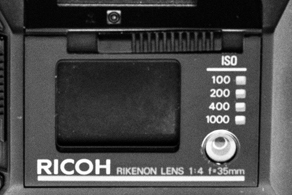
The ISO is set manually using the lever to the side of the lens, matching the appropriate ISO of the film inserted. It offers just four film ratings, 100, 200, 400 and 1000. There is a pop-up flash.
Images from the Ricoh can be quite acceptable, for a ‘point and shoot’ which allows a little bit of creative input, certainly it will make decent 6×4 inch prints, and I’ve been told some have got reasonable 10x8s from it.
 Portraits2Go.co.uk