This project was about evangelicalism in Northern Ireland. Up to this point, I had been looking at how the secularisation of society had impacted on evangelical beliefs, practices and worship styles, in the evident decline of the mission-hall culture in the province. But how are the evangelicals striking back? There are a number of different answers to that question, but at least in Northern Ireland, one of the most visible ‘attacks’ on secularism, historically and consistently used by evangelicals and fundamentalists is the strange practice of nailing messages to trees throughout the countryside. A number of these placards had been erected around the Ards Peninsula.
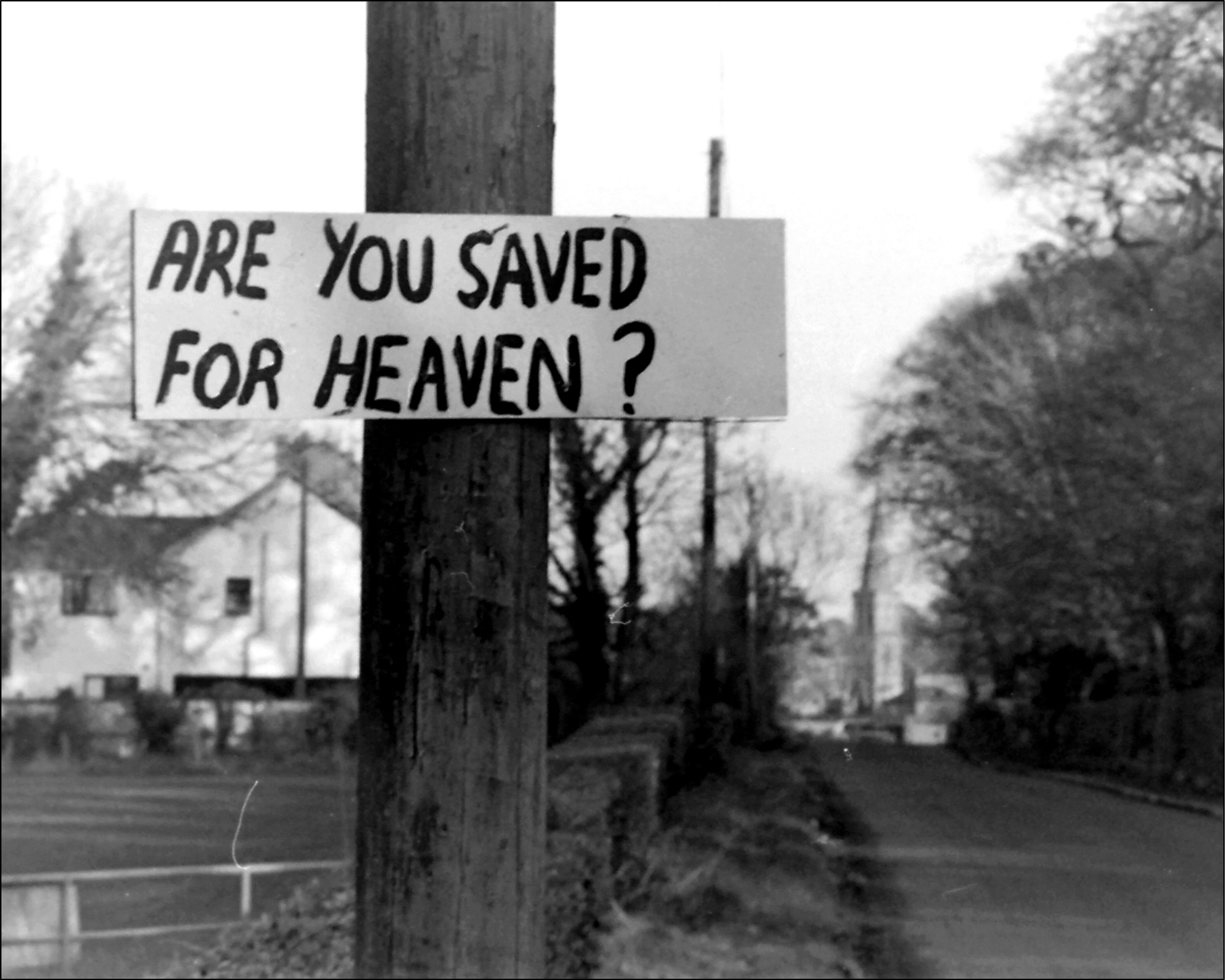
One of the sites where this had occurred was on the Woburn Road, Carrowdore, where the sign read, “Are you saved for heaven.” Not in itself a biblical quotation, it was placed, whether deliberately or not, with a Church of Ireland Church in the background. The steeple of the church, an architectural statement, encouraging worshippers there to raise their eyes spiritually heavenward, is utterly contradicted by the message of the placard, insisting that only the ‘saved’ can attain a heavenly reward.
I visited the location on two occasions. On 4th March 2010, I took the Nikon F100, loaded with Ilford FP5 film, B&W, ISO 400. I metered the light at f/11 @ 1/250th sec. The film was developed in FotoSpeed developer for 7 minutes, stopped and fixed, and scanned into a computer. In photoshop it was cropped and had the levels balanced. The result was as follows:-
I returned to the location on 7th March 2010 with the Nikon D700. My purpose was to see if I could get a better focus on the church, necessitating a better depth of field, and a smaller aperture. I set the camera on aperture priority, and the aperture at f/22. At ISO 200 (I wanted a quality image, worthy of an exhibition) the shutter speeds were quite low, around 1/20th sec., so I mounted the camera on a monopod. (A tripod was a little impractical due to the slope of the grass bank on which I was standing.) I made a series of exposures, some with the focussing point on the sign, others with the point on the church. Following Curto’s advice to ‘zoom with your feet’ I moved firstly away from the sign and then closer to it, – I wanted the steeple of the church to be correctly positioned, juxtaposed beside the sign to accentuate the incongruity implied.
The resultant images were imported into Photoshop and any low quality shots were deleted. I chose a number of images to be included in my ‘working files’ folder, and of those, my favourite was DSC_7331. I opened the original unprocessed jpeg in Photoshop:-

After some experimentation I decided that a square crop looked best, giving the image the most visual impact.

The resultant crop had a levels balance applied:-

I wanted the sign to have a greater impact on the eye. I duplicated the layer and drew a selection marquee round the white placard, then re-balanced the levels to make the green wording more prominent.
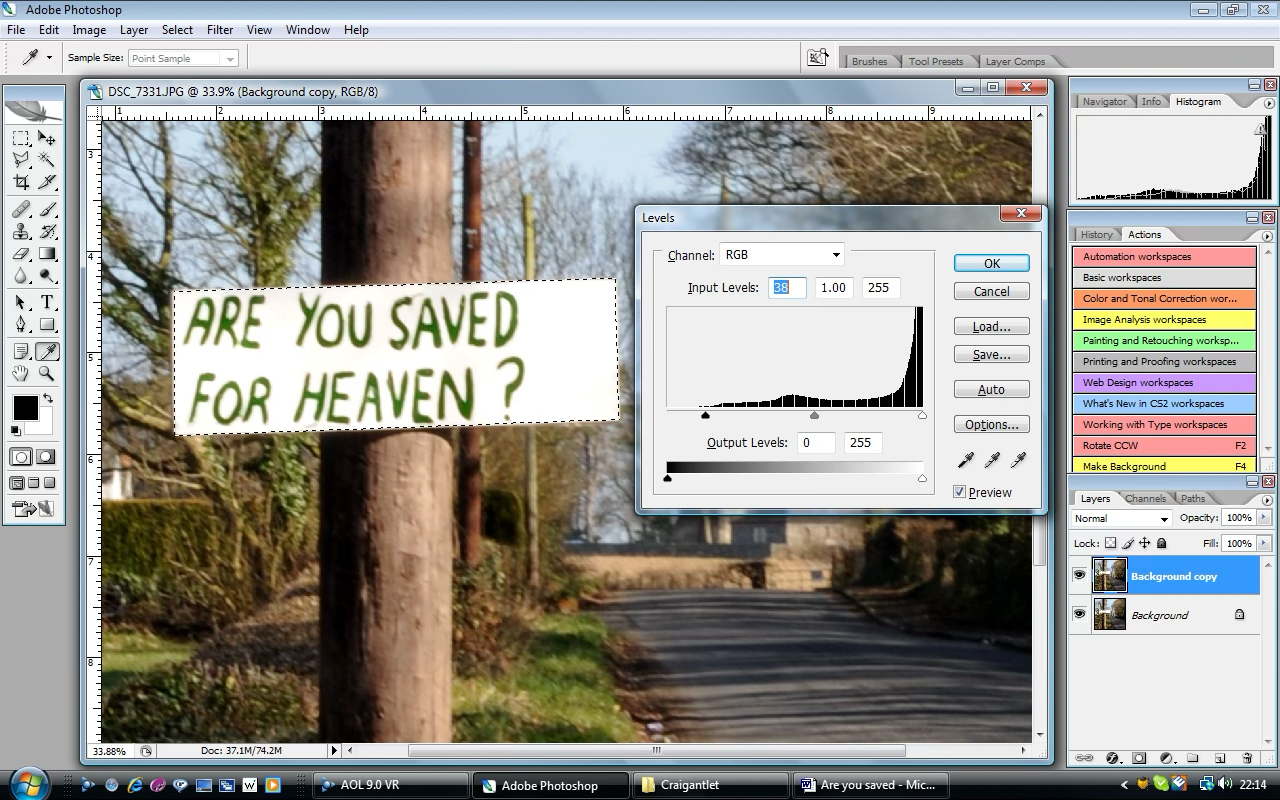
The final image, now 12×12 inches, was saved at high resolution, and made ready for printing.

I really liked this image. Apart from the slightly quirky message and its deeper expression of modern cultural fundamentalism, it is visually attractive. There are lots of converging lines, made by the road, the telephone poles and wires, the grass verges and banks, leading the eye into the photograph, and towards the church were the mind is being drawn. If the pole and the placard had not existed, this would have been a lovely country landscape, a peaceful, tranquil scene, perhaps almost ‘Constable-like’ in its serenity.
Yet STOP! The beautiful, contentedness of the image is abruptly halted, as the eye is arrested by the pole and the sign. It is a disruption of man’s ideas of the way of peace. It is a warning. It is a roadblock on the way to conventional religion. It is the hand-written outpouring of an enthusiastic heart, set against the formality of an architectural expression of religion. It spoils the serenity, it startles the eye, it screams its message. In this image at least, perhaps it has even achieved something of its writer’s intention.
 Portraits2Go.co.uk