Another gem of Belfast’s architectural heritage, this Grade B1 listed, triangular building (known locally as ‘the smoothing iron’) in Little Donegal Street, Belfast, was once the premises of Robert Watson’s furniture manufacturing company, suppliers of beds to the Royal family, and whose beds were installed in many luxury liners built in Harland and Wolff, the Belfast shipyard, including the Titanic. The building was designed by William J Fennel and built between 1898 and 1907, originally known as ‘Library House.’
As a boy of 12 or so years of age, so, in the late 1960s, a real treat was a Saturday afternoon in Belfast City Centre with my grandfather, – for although he seemed to spend ages browsing through the stock in various tool and equipment stores, – what would probably be known now as DIY shops. But the compensation for this period of boredom would be when we eventually got to Smithfield, the old ‘shambles’ style covered market in between Royal Avenue and Millfield, off Gresham Street. Smithfield wasn’t a market with stalls, nor a modern style shopping centre, but a unique shambles of musty run-down outlets packed with books, records, tools, second hand furniture, bric-a-brac and much much more, including a popular ‘joke shop’ – every small boy’s favourite.
To get to Smithfield from the city centre bus stops required a walk along Queen’s Street, and then along Chapel Lane, and past the Roman Catholic Church of St Mary, and its strange and imposing Marian shrine. To a small boy, not of the Catholic persuasion, and unused to Catholic piety, the shrine appeared mysterious, unwelcoming and even frightening. We hurried past it with eyes looking away and heads bowed.
The remaining three blocks of multi-storey apartments at Rathcoole, Newtownabbey. There were originally four blocks, built in 1965 by John Laing Construction, were 140 feet high, and contained 65 flats.
Continuing the occasional series featuring my eclectic collection of cameras, here’s the
Jiffy Kodak VR Art Deco Camera
This fascinating little camera came into my possession when some of the remaining possessions of my wife’s late grandfather Sam Scott were being sorted through, quite a while after his death.
The famous Belleek Pottery, in Co.Fermanagh, Northern Ireland. Photographed with a Fujifilm X-T30 on Acros film simulation mode, with (digital) red filter added in-camera.
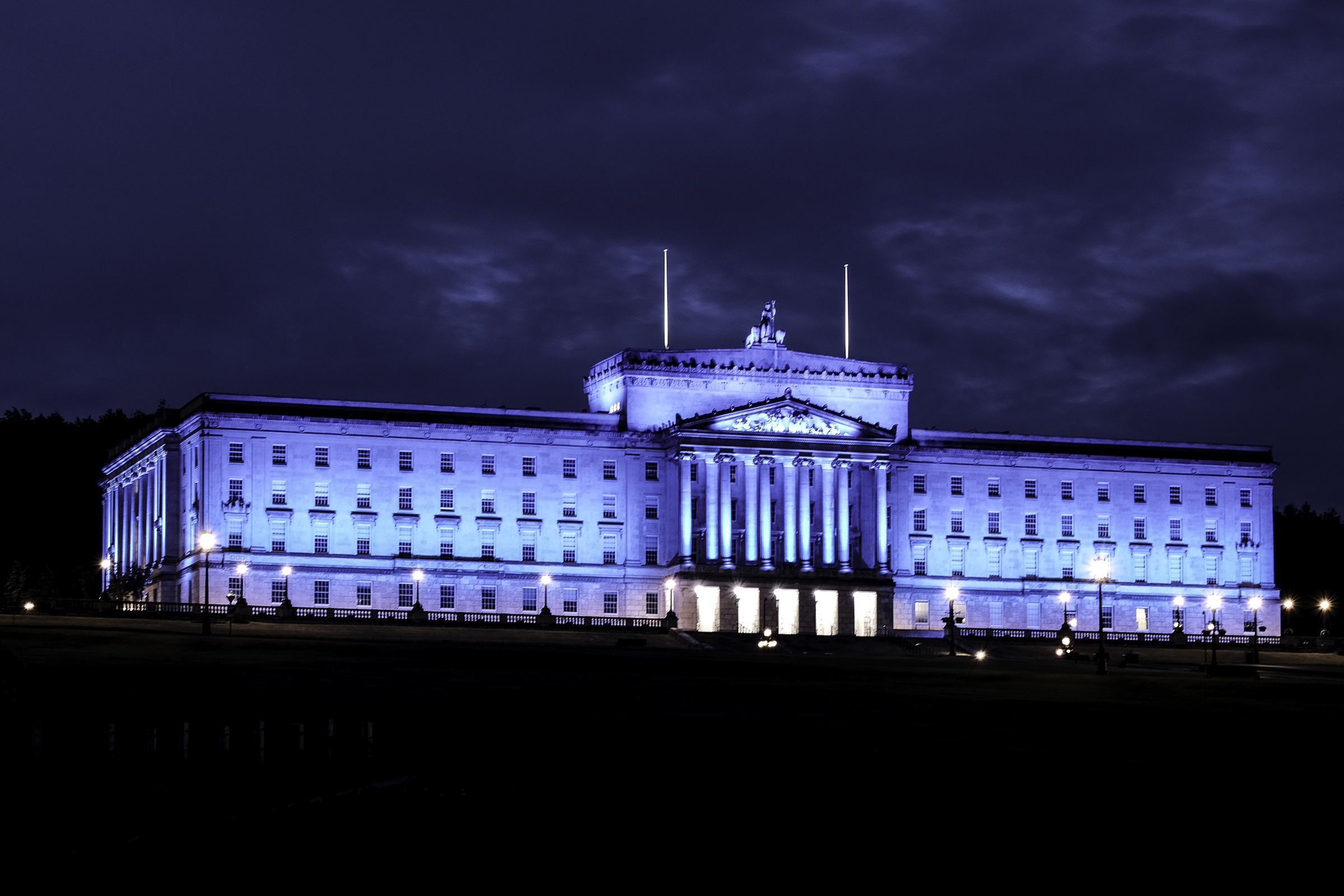
On Tuesday 22nd June, 2021 our local seat of government, the classic Parliament Building of Stormont, Belfast, was illuminated in blue, to mark the centenary of the first sitting of the Northern Ireland Parliament in 1921. I was commissioned to photograph the building, for publicity purposes, by Traditional Unionist Voice, one of the local political parties, whose initiative had led to this special commemoration event.
Stormont in Blue 1 – F=44mm, f/8 @ 5 secs on ISO1600
It’s encouraging to drive along a road and see some inspirational words on a wall. In Belfast, it makes a nice change from some of the darker, paramilitary or terrorist inspired murals. Ant when you are ‘getting on a bit’ like me, this wall on the Newtownards Road is particularly appropriate – a good incentive to keep going!
Fujifilm X-T2, Acros Film Simulation, F=18mm, f/6.4 @ 1/125th sec on ISO400
This area of Belfast is known as ‘Ballymacarrett’ – an ancient townland name, and the home of many of the old Belfast industries, most notably the famous Harland and Wolff Shipyard, Short Brothers aircraft factory, the Belfast Rope Works and the Scirocco Works.
The mural features everything that is good about East Belfast, its community and renown, including CS Lewis, born in East Belfast. Also included are a ballerina, Belfast City Hall, and a group of children playing in the street, a boy releasing a dove, symbolising peace.
The main text on the mural is:
You are never too old to set another goal, or to dream a new dream.
The Martin Memorial Clock Tower – beloved monument or ‘a decrepit eyesore?’
Back in September, 2020, Janette and I did a drive around the Lecale District, an area of outstanding natural beauty, not too far from where we live in Co.Down. I did three blog posts about that area, and in the first of those pieces, https://bobmcevoy.co.uk/2020/09/01/the-lecale-district-1/ I mentioned Van Morrison’s song, “Coney Island.” (Is it really a song?), in which Mr Morrison, one of our native sons, mentions many of the local places of interest in this part of Northen Ireland. But one of the lines of the song intrigued me. For Mr Morrison writes of driving through Shrigley to take photographs before he travelled on down to Killyleagh.
Between Dundrum and Newcastle, Co.Down is this ancient Dolmen, a strange stone structure that stands out against the skyline.
Slidderyford Dolmen
It is generally supposed that these stone structures mark burial grounds, probably from around 3000-4000 BC. Who built them, or how they were built is a mystery, it seems, but they occur all over Western Europe. Notice how the heaven top rock seems to fit into ‘sockets’ on the supporting rocks, and marvel at ancient engineering skills! To visit the Dolmen take the A2 road from Dundrum to Newcastle, and on reaching Murlough Nature Reserve turn onto Old Road, The Dolmen is on the left. Be aware though, that the tomb is sited on private land, which often is sowed out in crops, and to cross over to the monument would be trespass. It’s wise to take a medium range zoom lens if you want to photograph the Dolmen, and work from the road verge.
I visited the Dolmen on a bright afternoon, so conditions for photography were not optimal. I had to overexpose by around 2 stops to bring out some detail in the stones, which left the sky overexposed. I’d no tripod with me, so no opportunity for a series of shots for HDR processing.
The images above was made with the Fujifilm X-T2, F=180mm, f/8 @ 1/250th sec on ISO250.




 Portraits2Go.co.uk