Another gem of Belfast’s architectural heritage, this Grade B1 listed, triangular building (known locally as ‘the smoothing iron’) in Little Donegal Street, Belfast, was once the premises of Robert Watson’s furniture manufacturing company, suppliers of beds to the Royal family, and whose beds were installed in many luxury liners built in Harland and Wolff, the Belfast shipyard, including the Titanic. The building was designed by William J Fennel and built between 1898 and 1907, originally known as ‘Library House.’
As a boy of 12 or so years of age, so, in the late 1960s, a real treat was a Saturday afternoon in Belfast City Centre with my grandfather, – for although he seemed to spend ages browsing through the stock in various tool and equipment stores, – what would probably be known now as DIY shops. But the compensation for this period of boredom would be when we eventually got to Smithfield, the old ‘shambles’ style covered market in between Royal Avenue and Millfield, off Gresham Street. Smithfield wasn’t a market with stalls, nor a modern style shopping centre, but a unique shambles of musty run-down outlets packed with books, records, tools, second hand furniture, bric-a-brac and much much more, including a popular ‘joke shop’ – every small boy’s favourite.
To get to Smithfield from the city centre bus stops required a walk along Queen’s Street, and then along Chapel Lane, and past the Roman Catholic Church of St Mary, and its strange and imposing Marian shrine. To a small boy, not of the Catholic persuasion, and unused to Catholic piety, the shrine appeared mysterious, unwelcoming and even frightening. We hurried past it with eyes looking away and heads bowed.
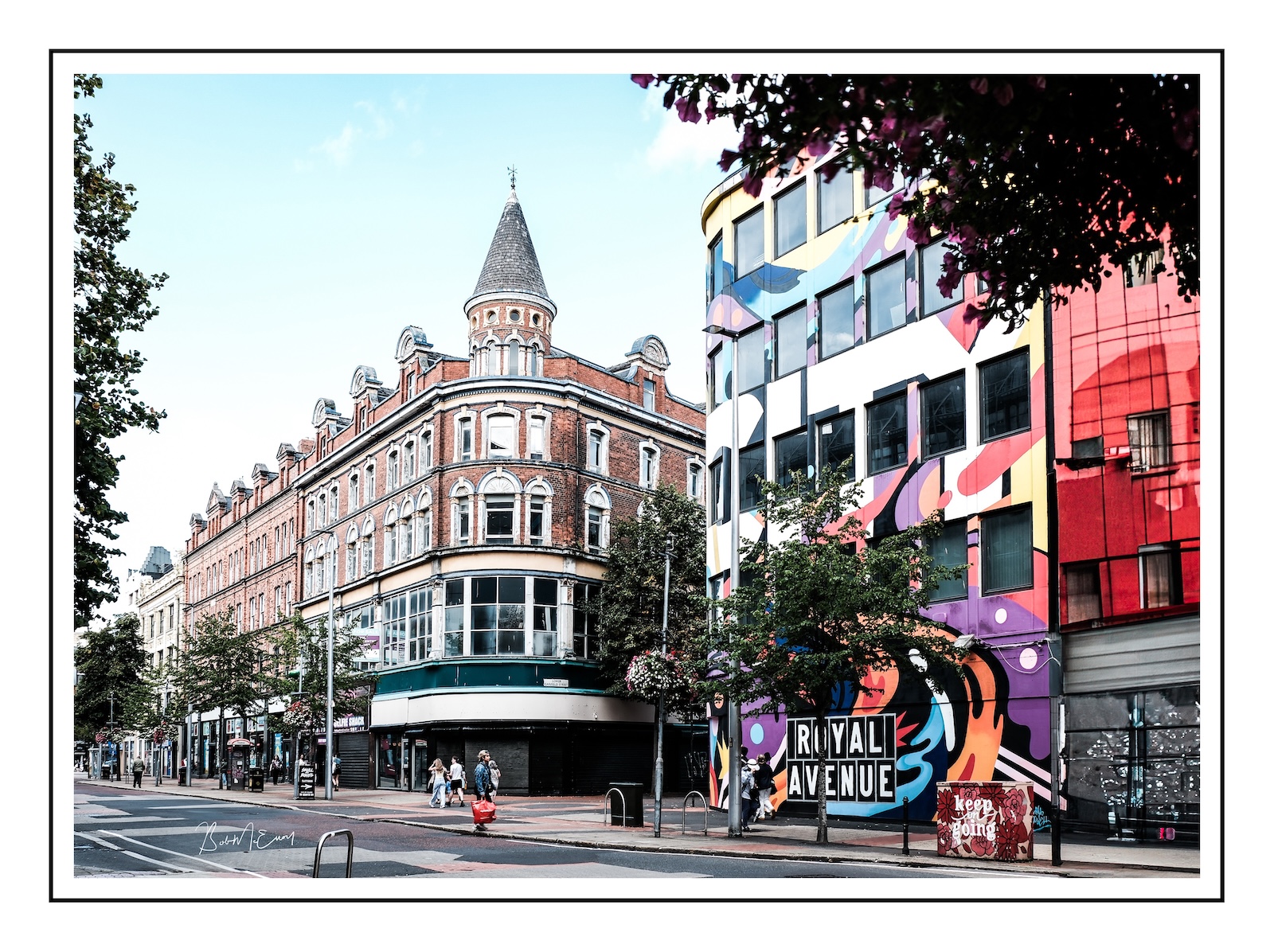
A city centre walk around Belfast brought me to Royal Avenue,, where classic Victorian architecture clashes with garish modernism. This example stands out…
Fujifilm X-T50 F=18mm, f/5.6 @ 1/60th sec, on ISO80.
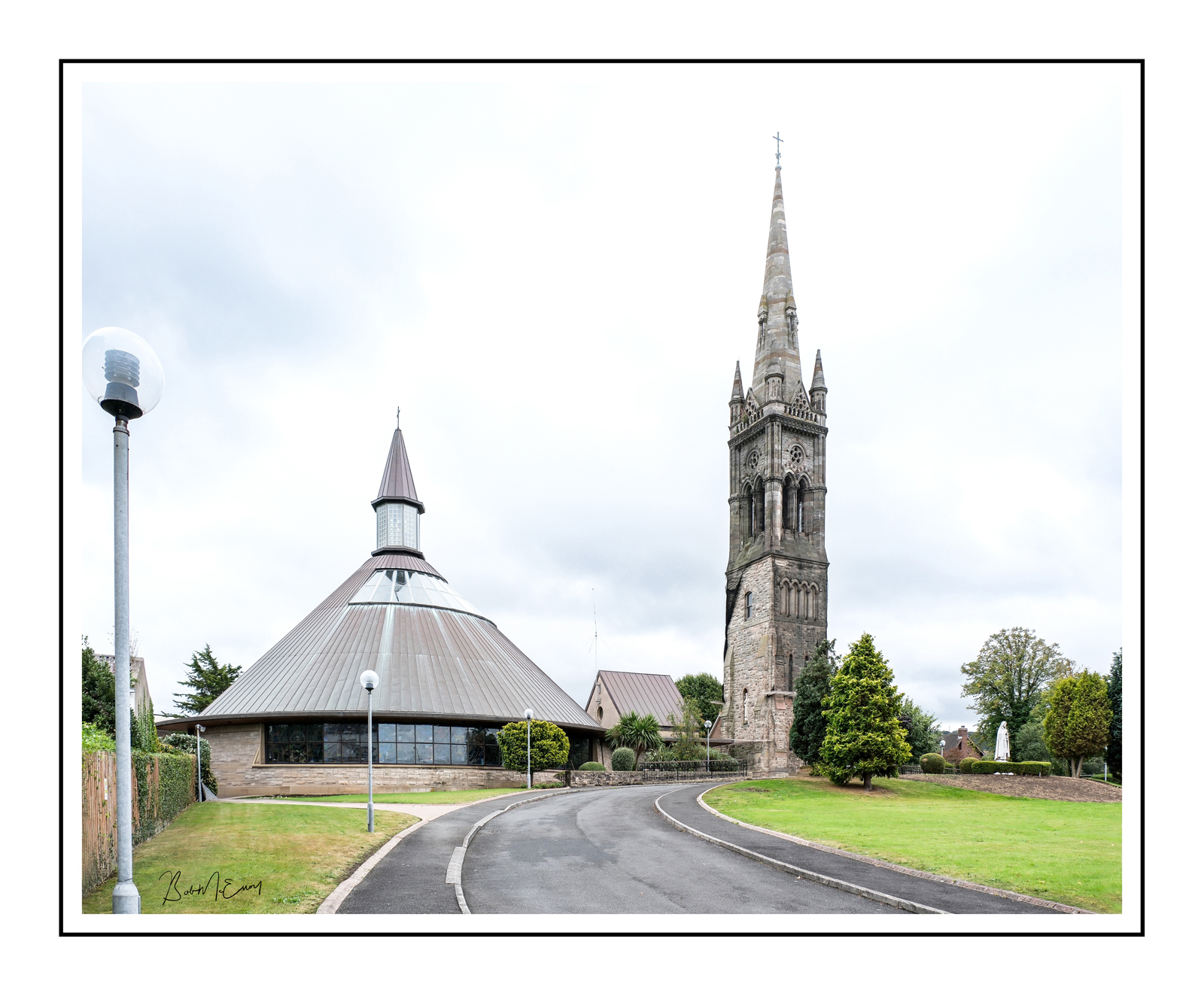
Holywood, Co.Down is a (rather posh!) suburb in North Down, between Belfast and Bangor, and part of Northern Ireland’s gold coast, – the so called ’stockbroker belt.’ I happened to be driving through it on Monday 1st September 2025, en-route to Newtownards. As I drove past St Colmcille’s Catholic Church, I reminded myself that I’d promised to take a closer look at this remarkable building, set high on a hill on the approach to the town, a fusion of an old bell-tower and a modern circular building. So, on my return journey, I stopped for twenty minutes or so, armed with the Fujifilm X-T50.
Scrabo Fields As the August sun bathes the fields leading up to Scrabo Tower in Newtownards, Co. Down, the round straw bales stand like golden sentinels, the product of the summer’s growth.
The bales reflect the warmth of the season and the beauty of rural life. Captured by the Fujifilm X-T50.
Squires Hill, Belfast, viewed from Cave Hill Country Park.
Today, Thursday 7th August 2025, I had a few minutes to snatch a packed lunch sandwich between appointments, and where better to stop en-route, than the Cave Hill Country Park.
After the quick lunch, I jumped out of the car to look at the stunning views across the city, and the surrounding countryside, a moment or two in a busy day, to soak in the stunning views of the Lagan estuary and the beautiful hills that cradle our city, from the Castlereagh and Holywood Hills in the south to the majestic Black Mountain range in the north It’s hard not to fall in love with this landscape.
It was a reasonably good day, meteorologically, warm and not raining for a change, so I suggested a trip to Belfast might be a good way to put in the day, – after all, I’m meant to be resting this week… And with me went Janette, my long suffering wife, and the Nikon FM3a.
So we caught a train at Antrim Station. If you’ve visited here, and never used Northern Ireland Railways, you should put that right on your next visit. The trains are modern, clean, warm and safe, and best of all, they are mostly on time! Not bad from a state owned company!
Can you ever tire of photographing a river? I now have a whole folder of images from the Lower Bann, that majestic river that flows from Lough Neagh out into the Atlantic Ocean at Coleraine.
Many of them are made from the western side of the river, accessed by The Fisherman’s Walk, and on those occasions I have looked across the Bann to a small jetty, about half a mile or so upriver, on the other bank.
Situated at the edge of the Bann Estuary in County Londonderry, this quaint abandoned cottage was built around 1600, by fishermen who trawled the waters for the salmon who travel up the Bann.
This wily old bird sits on the barrier at Tannaghmore Service area, on the A26 road between Antrim and Ballymena, and stares at motorists eating in their cars, knowing that eventually someone will cave in and give it a morsel or two.
(Ok, I’m not an ornithologist, so I don’t know if it’s a crow, or a Jackdaw, or a Rook, or whatever!)
But I do know it was photographed with the Fujifilm X-T5, F=300mm, f/5 @ 1/500th sec on ISO400