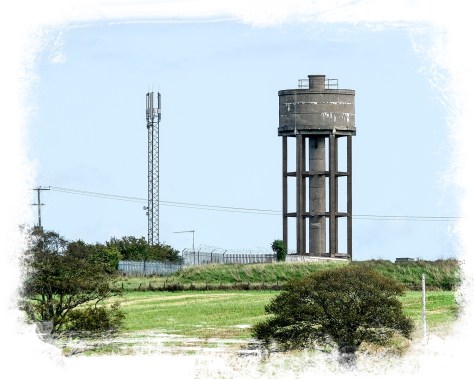
The old water Tower on Galloway Hill, close to Moneyreagh, Co. Down is listed on the community website, https://moneyreaghdistrictcommunityassociation.btck.co.uk/ as being one of the significant landmarks of the village! It is certainly visible for quite a distance around, but as a landmark it probably lacks a little in the beauty department. Still, I suppose its mostly only seen in the distance, as this photograph, taken from Tullyhubbert Road shows, and from a distance it doesnt look too bad.
Fujifilm X-D2 200mm lens, f/9 @ 1/250th sec on ISO200.
So, in the interests of bringing its lovely ‘landmarkedness’ to the wider public, I drove up Tower Lane to reach said monument to the human desire for thirst quenching wateriness, and record it from closer distances. Continue reading Moneyreagh Water Tower→
I’ve often driven along the M2 between Antrim and Templepatrick, and wondered about the little church, nestling up in the trees above the moterway. Today my curiosity got the better of me, and on the way home from a wedding I drove up to the church to get a closer look. It’s St John’s Church of Ireland, and it sits amidst a churchyard with some very ancient graves and tombs. Continue reading St John’s Church, Donegore→
Should we ever make/share photographs of children on the streets or public places without asking for their parents’ consent?
The question arises because of the photograph above. I was in the Guildhall Square in Londonderry, photographing the fountains, when this little girl ran right into the spaces between the water sprouts and began to dance about. (It was so unexpected that I didn’t even get time to refocus or adjust the camera to include her feet and legs.)
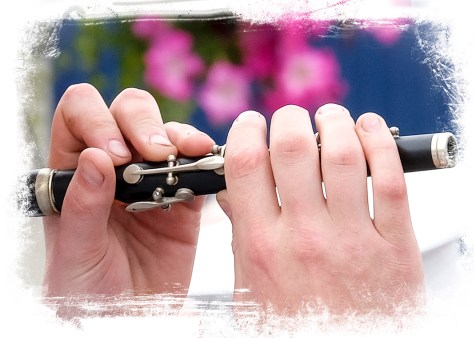
Love it or hate it, the Twelth of July celebrations are a huge part of the culture in Northern Ireland, and by and large they are synonymous with marching bands. Flute Bands in particular!
Originally known as ‘The Olivet Home’ it was built to be an orphanage in 1886 by Alexander Orr Reid as a memorial to his only son who was killed in a shooting accident. It was purchased by Ballygowan Presbyterian Church in 1918 and used as a school and church hall. The inscription on the building is ‘The Time is Short’ – thought to be a reference to the death of one of the construction workers, who fell to his death from the roof. A white stone on the top of the tower marks the event.
Hillsborough is one of the trendy, affluent areas of Northern Ireland. Situated on the A1 between Dromore and Lisburn, Hillsborough boasts a fine park with a lake, historic buildings, a fort, and even a Royal Residence (Hillsborough Castle).
I visited the town for a ‘walk with a camera’ one morning recently, when the sun was shining and it was around 24 degress celsius. Here’s a few of the images…
I like the city’s skyline, and I’m ashamed at how many time I admire it from the comfort of a car! Today however, due to a convergence of coincidences, I happened to be in the front passenger seat of a car, with a camera in my hand, – so I wound down the window and took a few shots. Not easy, for there were quite a few other vehicles on the road at the same time. Continue reading Moving Experiences in Belfast!→
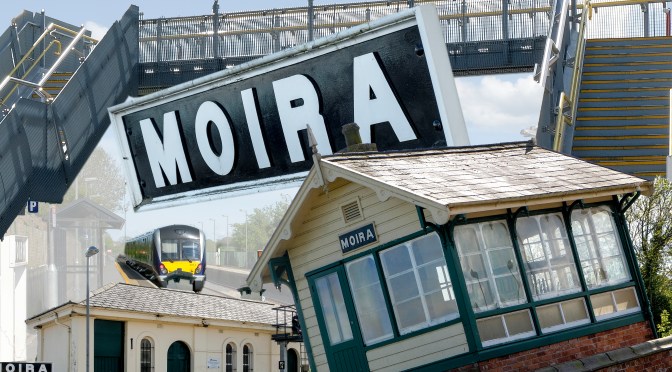
Moira, historically in the County of Down, is served by NIR (Northern Ireland Railways), via a station around 1 mile outside the town, and actually situated in Co Antrim. The line is the Belfast to Portadown line, and Moira lies between Lisburn and Lurgan.
The station boasts a rather fine (although now disused) signal box and is the oldest station still in use on the NIR network, opened on 18 November 1841. Its hard to believer now that just as recently as 1945 the station was manned by a staff of 15 men, including the stationmaster, porters, signalmen etc. Now no-one works here at all.
A wee visit to Donegal, the northernmost couty of the Irish Republic, and a stop for lunch in Londonderry on the way left me with a little bit of time to make some photographs, using the Fujifilm X-T2. Here’s some of the images:-







 Portraits2Go.co.uk